Whenever I go to the doctor's office, the nurse always takes some "vitals"; things like blood pressure, temperature, pulse rate, etc. These measures of basic body functions are helpful in detecting or monitoring medical problems. Google has introduced it's own set of "vitals" for what it deems as a healthy web page.
|
It has been a while since Google communicated the design standards of desktop to mobile responsiveness and https safety. These are now must-haves for websites. On May 28th of 2020, Google introduced Core Web Vitals to the world. It was a new set of Google ranking signals focused on speed, user interactivity, and stability of a web page. The new “vitals” are considered essential targets for Google as they all improve the user experience. |
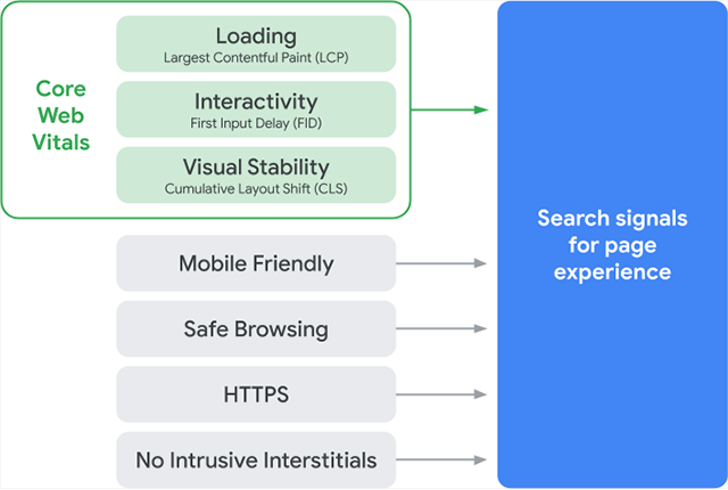 |
Though they were announced in 2020, these scores were set to be rolled out in a core algorithm in summer 2021. They are now an important ranking signal for all site pages.
The Purpose of CWV
- Prioritization of the user experience is #1. If users have a good experience on our site, Google aims to rank it higher.
- Performance targets are simplified and standardized. We know exactly what Google thinks is best for the user experience and what they will judge / rank sites on.
Measures of CWV
The overall scores is a combination of several factors but centers in these three areas. The page evaluated will get a 0-100 overall score. Good is 90 to 100 (green). Needs Improvement is 50 to 89 (orange). And Poor is a score of 0 to 49 (red).
| Largest Contentful Paint – speed of page load; painting the largest elements on the page. LCP measures loading performance and is focused on the largest elements. These are typically images or videos. However, it could also be a large text field. | 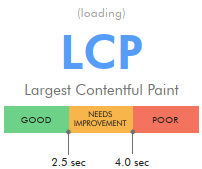 |
| First Input Delay – speed of user interaction with the page. First input delay is focused on the time it takes for a user to be able to interact with a page (such as clicking a button or tapping a hyperlink) and when the browser is able to start processing that interaction. | 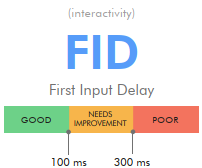 |
| Cumulative Layout Shift - visual stability as it loads. This measure looks at unexpected layout shifts when a page is loading. You have experienced this before on a mobile device. As the page loads some elements shift up and down as the elements of the page load (like ad banners or social post links). | 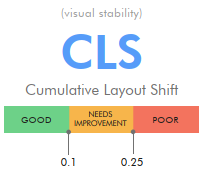 |
How do we measure up?
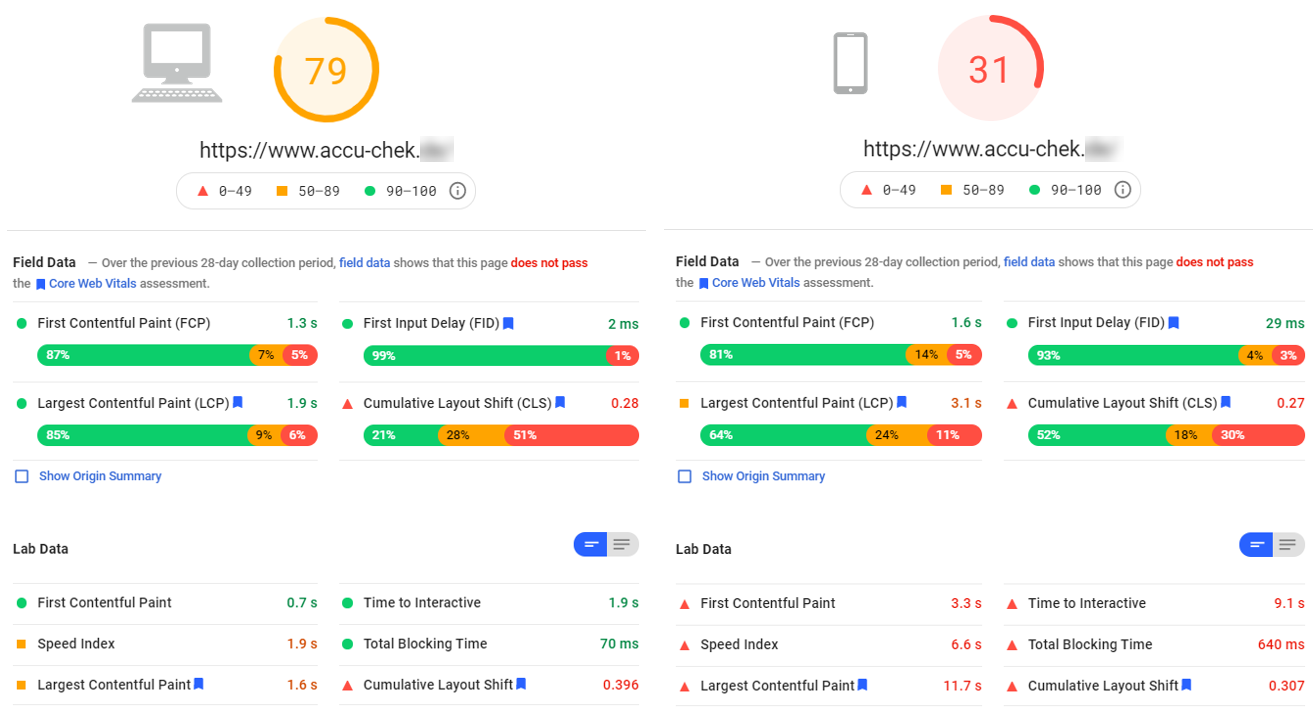
While there are many elements in which we score well, overall most of our Roche Diabetes Care (accu-chek.XX) sites score in the Needs Improvement range for desktop. For mobile, we score lower. You can see in the example below that we have work to do in LCP and CLS areas. This is primarily due to code bloating with unneeded JavaScript as well as non-optimized images.
What is Roche Global Marketing doing to help?
This is the beauty of having a focus on search optimization. SEO is essential to ensuring our digital presence is the best experience for users possible. Global Marketing and Customer Experience is investing heavily in you and your sites. We are actively working in the following areas to improve scores and increase the ranking of Accu-Chek sites.
- JS/CSS clean up and optimization
- image optimization
- implementing structured data
- global rollout of fixes across multiple sites
Want to learn more about Search Engine Optimization (SEO)? Check out these other articles:
- What is Search Engine Optimization (SEO)?
- Content creation can be as easy as 1,2,3!
- What is On-Page SEO?
- What is Off-Page SEO?
- How Do Search Engines Work?
- Think Like Google