Global Marketing Operations SEO Educational Article Series
This article is part of a series to help you understand the basics of Search Engine Optimization. Please check out the list of other articles at the end of this article or located in the Affiliate Support Desk.
Why is Understanding Keywords Important
In the article, How the Internet Has Changed Everyday Life, the author states that, “The Internet has turned our existence upside down. It has revolutionized communications, to the extent that it is now our preferred medium of everyday communication. In almost everything we do, we use the Internet; ordering a pizza, buying a television, sharing a moment with a friend, sending a picture over instant messaging.” “The Internet has changed business, education, government, healthcare, and even the ways in which we interact with our loved ones—it has become one of the key drivers of social evolution.” (1)
Given the proliferation of smartphones, online content, and internet use, it just makes sense that our online behavior around our health has changed as well. A recent Pew Internet & American Life Project study stated, “80 percent of Internet users, or about 93 million Americans, have searched for a health-related topic online. That’s up from 62 percent in 2001. (2)
Words are at the core of much of our human experience. “To humans, words are more than a means of communication; they can shape our beliefs, behaviors, feelings and ultimately our actions. Words are one of the most powerful tools that we as humans possess; they can ignite revolutions or defuse tension.”(3) In fact, consumers most often turn first to a keyword search, regardless of what device they start with, when researching health needs. (4)
As a leading brand in diabetes care, it would be easy for Roche Diabetes Care to use its history, its past research, and even gut-level assumptions to approach understanding customers and target audiences' online behavior. Roche Diabetes has built groups, personas, segments etc., but often the personas are built from consumer surveys or offline research. These are perfectly valid techniques of course, but they may not accurately reflect online behavior. To truly provide relief to customers in the online experience, Roche Diabetes needs to know the underlying consumer needs that drive their search for answers. People often type questions into search engines that they’d never ask their doctor, their Facebook friends, or tell a customer research survey. This is where keyword research comes in. It can be a window of behavioral insight, a wonderful trove of customer information to mine and discover what people really want and need to know about their diabetes.
What are the types of Keywords?
Click on this article for an more in-depth explanation of the different keyword types.
What is Keyword Research
What is a keyword and why is it so important? Since 1960, the term “keyword” has jumped in use by leaps and bounds. It is defined as an informative word or concept of great significance. It is a word that acts as the key to a cipher or code. If insight into the customer is a treasure chest, keyword research can help unlock it.
Keyword research has been advancing dramatically over the last couple of years. Techniques like simply sorting by the highest search volume and creating a page no longer guarantee search engine success. Serving as a valuable online resource for customers is much more involved. The purchase path is changing from the traditional marketing funnel that most marketers have relied on. "Today, people are no longer following a linear path from awareness to consideration to purchase. They are narrowing and broadening their consideration set in unique and unpredictable moments. People turn to their devices to get immediate answers. And every time they do, they are expressing intent." (5)
Keyword Research
Understanding the search terms (keywords) that people use when they search and the intent behind them is crucial to creating content that both serves a purpose but also is findable by users. When someone is just starting a diabetes journey, searches and questions that person may ask may be broad in nature. But as they drill down into their pain points, the searches and questions become more specific. If we can get closer to identifying search intentions, or better yet the actual words they are using, we can more closely align our communications to them.
Note - We strongly recommend that you do not proceed with content development or a paid media campaign until you have completed the keyword research. Otherwise you may create content that the customer does not find useful or is not aligned with searches.
How many keywords do people usually use when searching?
Rand Fishkin, Founder and CEO of Moz presented a breakdown of Google search queries by length (Rand Fishkin):
1 word: 21.71% 4 words: 13.89%
2 words: 23.98% 5 words: 8.70%
3 words: 19.60% 6+ words: 12.12%
While 46% of searches use only one to two words, the likelihood of those turning into a purchase is extremely low. This means that roughly 54% of searches are using 3 or more words.
Keyword Research Tools
You can use any of the following tools to identify keywords that customers are using in content searches.
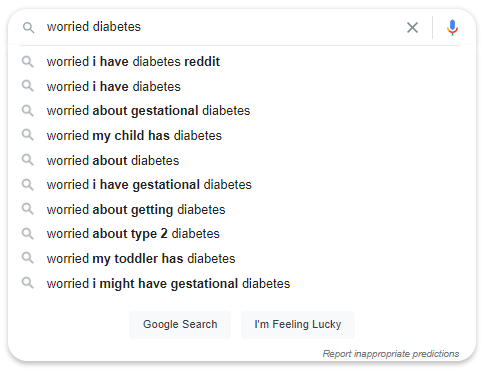
Google’s AutoComplete - Google provides you different ways to ask questions. As people type questions or statements into Google, it provides different suggestions to narrow down what they mean (their search intention). It shows the most popular keywords as the user types them. It can help a person refine as they search.
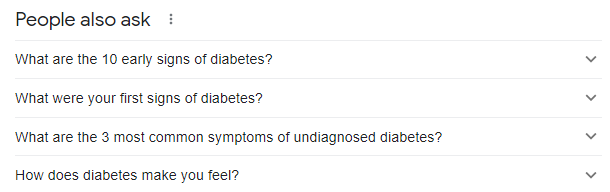
Similar to Auto Complete, Google’s People Also Ask suggests other related questions that users might be interested in. These accordion-like question and answer boxes are Google’s way of saying “these questions also relate to your search.”
One can then refine those words and ideas using different free tools such as AnswerThePublic, and the Keywords Everywhere plug in for Chrome to build a list of possible questions and wording variations along with their search volume, cost per click, and competition levels. Answerthepublic is a free tool that combines the suggested searches from Bing and Google and visualizes them in what could be called a search cloud.
Semrush is a SaaS platform. It is often used for keyword research and online ranking data, including metrics such as search volume and cost per click. The platform also collects information about online keywords gathered from Google and Bing search engines.
Moz Pro is an all-in-one suite of SEO tools. Crawl and audit your site(s), discover link building goals, explore on-page optimization opportunities
Google Search Console is a web service by Google which allows webmasters to check indexing status and optimize visibility of their websites.
Finally, if you are unsure how to use any of these tools or just want some help, contact us at the Affiliate Support Desk and we can help.
How do I know what keywords are important for me?
Keyword research involves identifying the words and phrases people enter into search engines that are most aligned to our business and what we can offer customers. Researching keywords gives us a few of things:
- Keyword research gives us a better understanding of how high the demand is for the keywords that we think are important to us.
- Keyword research helps us identify the many varied ways that people use language to research an idea or topic. We may not be aware of what people are feeling and thinking when they research their diabetes and the words they use. We must be open to leveraging the keywords customers use and not just the marketing focused words or internal words we like about our products and services.
- Keyword research can help fuel content development. Ultimately, by researching the words people type into search engines and using this research to create targeted-relevant content that directly meets the needs of customers.
Want to Learn More?
You can learn more about this topic and many others by exploring more articles listed below or by diving into LinkedIn Learning courses available through the Cornerstone OnDemand Learning.
SEO: Keyword Strategy, Link - https://roche.csod.com/LMS/LoDetails/DetailsLo.aspx?loid=3f6401f4-0021-55a2-87f5-456fdbb4ad89
Formulating a keyword strategy is one of the most important activities in marketing. Properly optimizing a website and strategically using keywords can yield visitors for years. This course covers important components of choosing keywords like how to determine customer intent, identify trends, develop analytics, utilize negative keywords, and focus on what works.
Sources
- Dentzel, Zaryn. “How the Internet Has Changed Everyday Life.” OpenMind. Accessed October 11, 2019. https://www.bbvaopenmind.com/en/articles/internet-changed-everyday-life/.
- Weaver, Jane. “More People Search for Health Online.” NBCNews.com. NBCUniversal News Group, July 16, 2003. http://www.nbcnews.com/id/3077086/t/more-people-search-health-online/#.XXZkcChJGUk.
- Richards, Erin. “The Power Of Communication: Psychology Of Words And Language Revealed.” Science 2.0, August 27, 2014. https://www.science20.com/erin039s_spin/power_communication_psychology_words_and_language_revealed.
- Decision Resources Group, Cybercitizen Health® Europe 2019
- “How Search Intent Is Redefining the Marketing Funnel - Think with Google.” Google. Google. Accessed October 11, 2019. https://www.thinkwithgoogle.com/feature/search-intent-marketing-funnel.