Did you know that:
- 60% of B2B buyers engaged with white papers during their buying process. (65% for video).
- 47% of them typically consumed 3-4 pieces of content before engaging with a salesperson amid making a purchase decision.
- 67% rely even more on content than they did last year to research and inform purchase decisions.
- 39% said research and survey reports were most valuable content formats and sources for researching your B2B purchases.
- 35% cited white papers and the most valuable.
- And, 81% of B2B buyers share business-related content with their LinkedIn network.
Demand Gen’s 2020 Content Preferences Study
Those statistics would lead us to believe that content marketing is pretty important for our business.
What is Content Marketing
Content is any information or entertainment that you share with others using text, images, audio or video. That is a huge bucket. Digital marketing and analytics expert, Avinash Kaushik puts it this way,
“Content is anything that adds value to the reader’s (or viewer’s) life. It can add value by making them smarter, making them laugh, making them do their job better, rush to share the video, make a contribution to a charity…”
In fact, this post you are reading right now is content. The key question is to what end result is the content publisher or author intending to drive toward. Content marketing is simply using content with a strategy and supporting tactics to benefit your business. Anyone can product content. When it is employed strategically, it can be a valuable and cost effective approach to drive customer engagement, gain customer feedback, create sales leads, or bring prospective customers into ‘the marketing funnel’.
Content marketing is important for Roche because our patients, HCP’s, payers and professionals have many unanswered questions. Content marketing can help answer those questions which builds trust with our audience, improves conversions, connects us with customers, and generates leads. The keys to great content are relevance and usefulness.
Everybody Can Write
Of course, creating great content takes good ideas, hard work, editing, etc. But, many people are not aware that content creation can be a pretty simple process. You may not think of yourself as a writer. You may think that only other people are creative or have enough “talent” to write. However, you write all the time. You write emails, presentations, plans… The issue is not that you cannot write. It is that you think you cannot write. Writing is a skill that is built. Like any other skill, it gets better with some guidance, practice, and feedback.
Here is a quick 3-step framework to get you started.
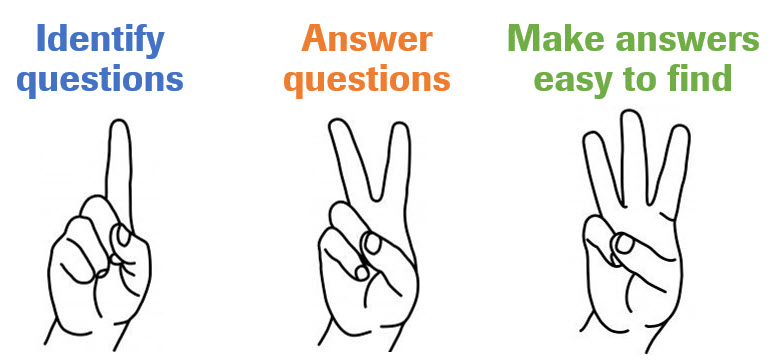
- Identify questions from our audience.
- Answer those questions.
- Make those answers easy to find.
1. Identify questions from our audience
| If you don’t already have a list of questions or concerns from your target audience, one of the easiest ways to get them is through keyword research. You spend a lot of time using sophisticated search tools or you can use an easy and free route - Google. People are asking What, Can, How, Will questions that directly pertain to pain points around diabetes. Google’s Autocomplete function is designed to “make it faster to complete searches that you're beginning to type.” As you type, Google suggests those items that are the most popular in search volume and match what you may be looking for. | “Good writing serves the reader, not the writer. It isn't self-indulgent. Good writing anticipates the questions that readers might have as they're reading a piece, and it answers them.”~ Ann Handley, Author of Everybody Writes |
By simply right-clicking on the Chrome icon and opening up a "New incognito window" in Google search, you can start exploring the issues people are having in diabetes management around the globe. Just look at some of the autocomplete suggestions from Google on the question "can I still ___ with diabetes".
Google Autocomplete Example - “Can I still ___ with diabetes”
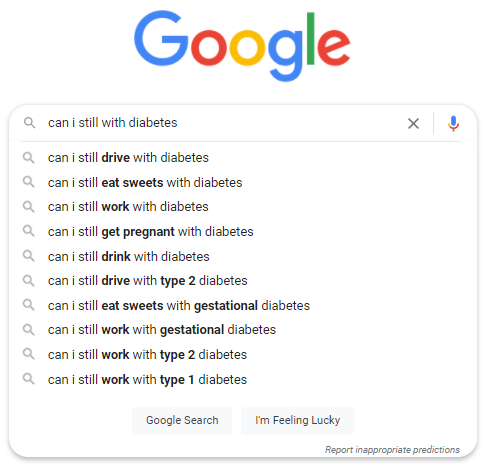
In this example, we can easily see that 4 of the top 10 autosuggestions deal with working. That is a very fast and easy way to see that there are many people out there asking if they can still work while having diabetes. Although it is comfortable for us to speak of features and benefits from a product perspective, the user is often wanting answers to life and how our products work in the context of their day to day situations.
|
Using a free plug-in for Google Chrome called Keywords Everywhere, I click on “can I still work with diabetes” and see that there are more refinements to that question. Such as:
|
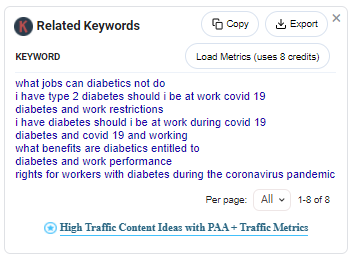 |
So, in just a few minutes, using free tools, I can find a potential story for patients centered in the concerns they have in work benefits, rights, and protections. And, I can see how those questions are actually worded in search queries.
2. Answer those questions
Now comes the creative part. The easiest part of content creation is simply answering questions. Great content is useful. Utility is a characteristic of usefulness, profitability, or benefit to the person reading it.
I realize that I am simplifying the writing process greatly. But, why does it need to be complicated? With just a little bit of research or leveraging our own HR colleagues, we can begin to build a content piece with advice, recommendations, or tips to help answer the question - “can I still work with diabetes.”
Once the piece is drafted, put it in front of those who can give you constructive feedback, then revise for readability. See our piece on readability. All content going on the website will go through content approval processes which will help it get better and ensure accuracy.
3. Make those answers easy to find
This is where some technical aspects and creativity meet. We already know how the user is searching for information. We simply need to speak the same language. In the article, we want to use the same words that the user is searching for as headings, subheadings, article text, quotes, etc.
Possible Article Title - Can I Still Work With Diabetes… Yes You Can!
Possible Subheading - Diabetes and Work Restrictions
Possible Subheading - What Benefits Are You Entitled to With Diabetes
Possible Subheading - Diabetes and Work Performance
Possible Subheading - Diabetes and Work Laws
By using the keywords of users and the structure of search engine optimization, we can make our content directly applicable to user needs and easy to find for Google (and therefore users).
SEO Tags for Headings
Placing the headings and subheadings into the meta-data of the article allows Google to see exactly what this article is about and serve it up as answers to user questions.
| Title Tag | <title>Can I Still Work With Diabetes… Yes You Can!</title> |
| Description (max 160) | <meta name="Description" content="Many people are concerned that having diabetes will affect their ability to work. Rest assured. You can still work with diabetes and we have some important tips for you."> |
| Heading 1 Tag | <h1>Can I Still Work With Diabetes… Yes You Can!</h1> |
| Heading 2 Tag | <h2>Diabetes and Work Restrictions</h2> |
| Heading 2 Tag | <h2>What Benefits Are You Entitled to With Diabetes</h2> |
| Heading 2 Tag | <h2>Diabetes and Work Performance</h2> |
| Heading 2 Tag | <h2>Diabetes and Work Laws</h2> |
| Alt Tag - Image | <img src="Imagename.jpg" alt="Insert a description of an image with your article"> |
| Open Graph Tag | <meta property="og:title" content="Can I Still Work With Diabetes… Yes You Can!"> |
How to do the same process for professional content
Regarding HCP’s or Payers, I did the same process. I looked up "__ for healthcare payers". I saw that one of the top 5 autocomplete suggestions was "challenges for healthcare payers". When I clicked on that, Keywords Everywhere confirmed the top three related searches were
- challenges faced by healthcare payers
- challenges facing healthcare payers
- what are the current challenges in healthcare
I clicked on the top article, Risks for Payers in the Healthcare Payments Landscape (https://www.instamed.com). In the article, we see some ideas for other keywords:
- Rising healthcare costs
- Uncertainty over healthcare reform / ACA
- IT / systems integration
- Aligning incentives with healthcare providers
- Consumer education / understanding of coverage & costs
- Consumer engagement / self-responsibility for health
- Rise in patient pay responsibility / high deductible plans
- Providers entering the payer space
- Providers consolidating
- Shortage of medical professionals for case management
- Rise in employer self-insurance
The main quote was, "Far and away, payer executives say their biggest challenges are costs and ACA uncertainty. But, about half of payers are also struggling with systems integration, aligning incentives with their providers, and consumer engagement and education." Using Autocomplete again, I saw a lot of questions on preventative measures and costs.
- preventive care cost benefit analysis
- preventive care reduce healthcare costs
- pros and cons of preventive health care
Now, I would not say that this is the definitive article to write. More confirmation of the professional audience and diabetes related keyword targeting may be needed. But, in 5 minutes, I am on a pretty good track.
Possible Article Title - Can iPDM Help Reduce Costs for Healthcare Payers?
Possible Subheading - How Does iPDM and Preventative Care Reduce Costs
Possible Subheading - iPDM and Healthcare Cost Benefit Analysis
This could be an excellent whitepaper or case study that is perfectly aligned with real life searches in Google.
To learn more, check out these posts:
- What is Search Engine Optimization?
- How Do Search Engines Work?
- What is On-Page SEO?
- What are Keywords?
“Your customers don't buy your product to do your company a favor.
They're doing it because your product makes their lives better.
So if you want to sell something, you need to explain how you're helping them.”
~ Nadia Eghbal, Head of Writer Experience at Substack