The largest search engine in the world – Google, understands that advertising is primarily how it is going to make money. So, they have built some ingenious tools to help advertisers get their brand messages to users of the network. Google AdWords is one of those tools.
What is Google AdWords?
AdWords is one of the primary tools that all search marketers use today. It allows you to “show your ads to the people who are likely to be interested in your products and services (across multiple devices) while filtering out folks who aren't.” AdWords allows users to build various ad campaigns and target those ads using multiple parameters such as:
-
Who – We can choose the age, geographic location, and language targets of our ads using demographics options.
-
When – We can target our ads to appear on specific days or specific times of the day, or how frequently.
-
Where – We can choose to have our ads appear in search results, in videos, on certain types of websites, or in mobile apps.
-
What – We can choose to link our ads to certain words, topics, and phrases that a user might enter in Google search.
- Which – And, we can choose which devices we want to show ads on; desktop, tablet, mobile device, etc.
Where can my ad be seen?
Using AdWords, you can place ads within multiple Google properties such as:
-
Google Search – text ads that appear in search results pages
-
Google Display Network – A library of various websites where Google controls the ad space and can place a larger image or animation ad.
-
YouTube – Google can place a video ad to run before other video content. You can select the audience you want based on age, gender, location, interests, and more. If the viewer skips the ad before the 30 second mark (or the end) you don't pay for that view.
- Mobile Apps – You can now show ads for an app within iOS or Android users on Google.
How is an ad campaign structured?
AdWords allows the user to design the ad campaign from a creative and a budget point of view. When you build a campaign, you will need to define a few things first. Let’s use the example of text ads within Google Search:
- How many campaigns do you want to run? AdWords can handle many campaigns at the same time. You can design and manage campaigns that run in parallel or one at a time. You can also build future campaigns that aren’t ready to run yet and archive older ones to adapt later.
- What are the words in your ad? Define the headlines, the copy, and the URL of the landing page that the ad will point toward.
- What are the kinds of words that should bring up your ads? These are called keywords. These words don’t have to be in the ads, but we need them to be relevant to the ad and the landing page.
- What variations of the ads do you want to make – A single ad may not perform as you hope. You will want to create multiple versions to test and then optimize (adjust) towards the ones that get results.
- How much are you wanting to spend in the campaign? AdWords gives you control over how you spend your money. There’s no minimum spend level and you can define a maximum limit to spend per month, per day, or per ad. Also, your budget is spent only when someone clicks your ad. That is why it is called Pay-Per-Click or PPC.
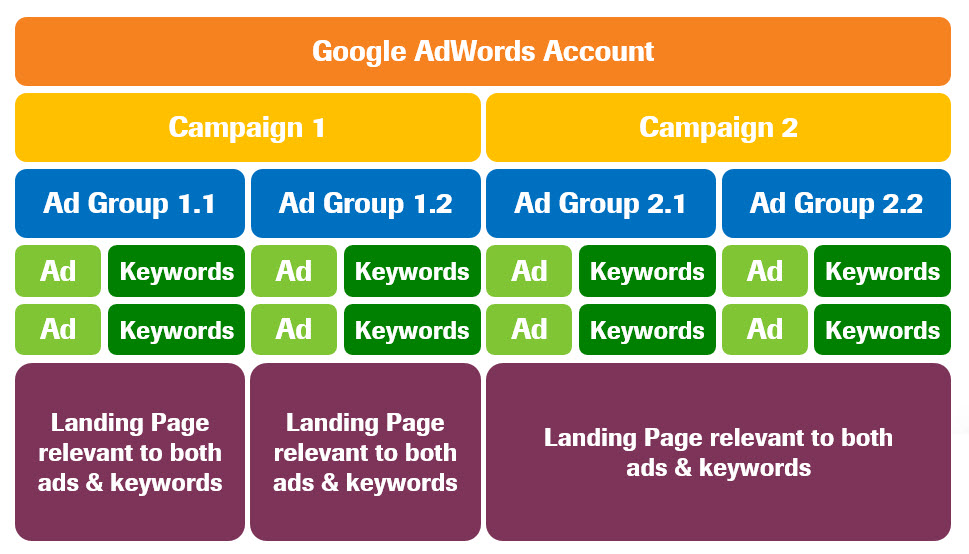
Under a single campaign, you can build multiple ads under multiple ad groups. For each campaign, pick one or a few focused objectives and create similar ad groups per objective. For each ad group, use keywords related to that focus. Multiple ad groups and ads allows you to hone your campaign for success. They may not all get interest, but it allows you to see what is working and what isn’t. It can also help improve Quality Score. In the ads themselves, use the actual keywords you are targeting in your headlines or copy. This helps the ad be more relevant to the user’s search.
How does Google choose whether to show my ad 1st, 2nd, 3rd, etc?
Google uses an algorithm to rate and prioritize AdWords ads, then determines which ones to show at the top of the page and which ones to push down the page. This is called Ad Rank. Ad Rank is calculated using how much you are willing to spend (maximum Cost-Per-Click) and how good it thinks your ad/landing page is (Quality Score). Ad Rank = (maximum CPC) x (Quality Score)
Take the keywords “blood glucose meter” as an example. Let’s say that Accu-Chek and OneTouch brands are competing to show their newest meter ad when a user types those words into Google search. Once the user starts the search, the battle begins. Within milliseconds, the rank is determined and the advertiser that has the highest product of maximum CPC bid and Quality Score wins and appears in first place (top of the page).
We can improve our rank either by being willing to pay more (increase our Max CPC) or by creating higher quality ads and landing pages that align to those keywords (Quality Score).
How is an ad campaign paid for?
It is worth noting here that appearing at the top or the results is not just a matter of money. As our quality goes up, Google lowers our prices and ranks us higher. As our rank goes up, our budget dollars are more powerful. In some instances, we can appear higher than our competitors in the results and pay less than them to do it.
In AdWords you can define how your budget is used; or a bidding strategy. You will want to think about what is most important to the campaign (goals) and allocate budget to those ends. You can choose whether you want to focus on getting ad clicks, reach / impressions, or conversions on the landing page. Some of the bidding strategy categories are:
-
Cost-per-click (CPC): This focuses on generating clicks on our ads and driving traffic to our sites.
-
Cost-per-thousand impressions (CPM): This is focused on getting the maximum number of ad views or impressions. This bidding is only available in the display network.
-
Cost-per-acquisition (CPA): This is focused on getting people to act once on the landing page or site. If we focus on conversions, then we may want to use a CPA bidding strategy.
There are many more and ways to be flexible in combining them.
How is an ad campaign measured?
Business management leader Peter Drucker cited as saying that "you can't manage what you can't measure." One of the beauties of using Google AdWords is that all of it is measurable. Once someone clicks on our ad, we will know about it. Using Google Analytics and AdWords reporting we will be able to see how the campaign is performing, how the budget is being used, and how the customer is behaving on our site. We can things like traffic volume, click through rate, which keywords are most popular, the cost per conversion, reach and frequency, etc.
How do I get started in AdWords?
Our global media program can do all of this for you and leave you to focus on the go-to-market strategy for your products. Just contact us and we’ll lead you through building a plan and campaigns to meet business needs.