People begin searching the internet by typing in words or phrases; those are called Keywords. As people keep searching for the best answer to their question, they will gradually start adding or changing words to be more specific. The process of adding keywords to a search is called the keyword tail or string.
Why are keywords important?
Keywords are important because they connect what people are searching for and the content you are providing. Your goal is to rank as high in the search engine result pages (SERP's) as possible. The keywords you choose to target will determine what kind of traffic you get. In order to create content that ranks well organically (non-paid) and drives visitors to your site, you need to understand the needs of those visitors — the language they use and the type of content they seek.
Having our ads appear in customer's search results cost money. Since we don't have unlimited budgets, it is important for us to understand what keywords most align to someone’s purchase intent. We do not want to show our ads and generate clicks on searches that don’t apply to our business or aren't specific enough.
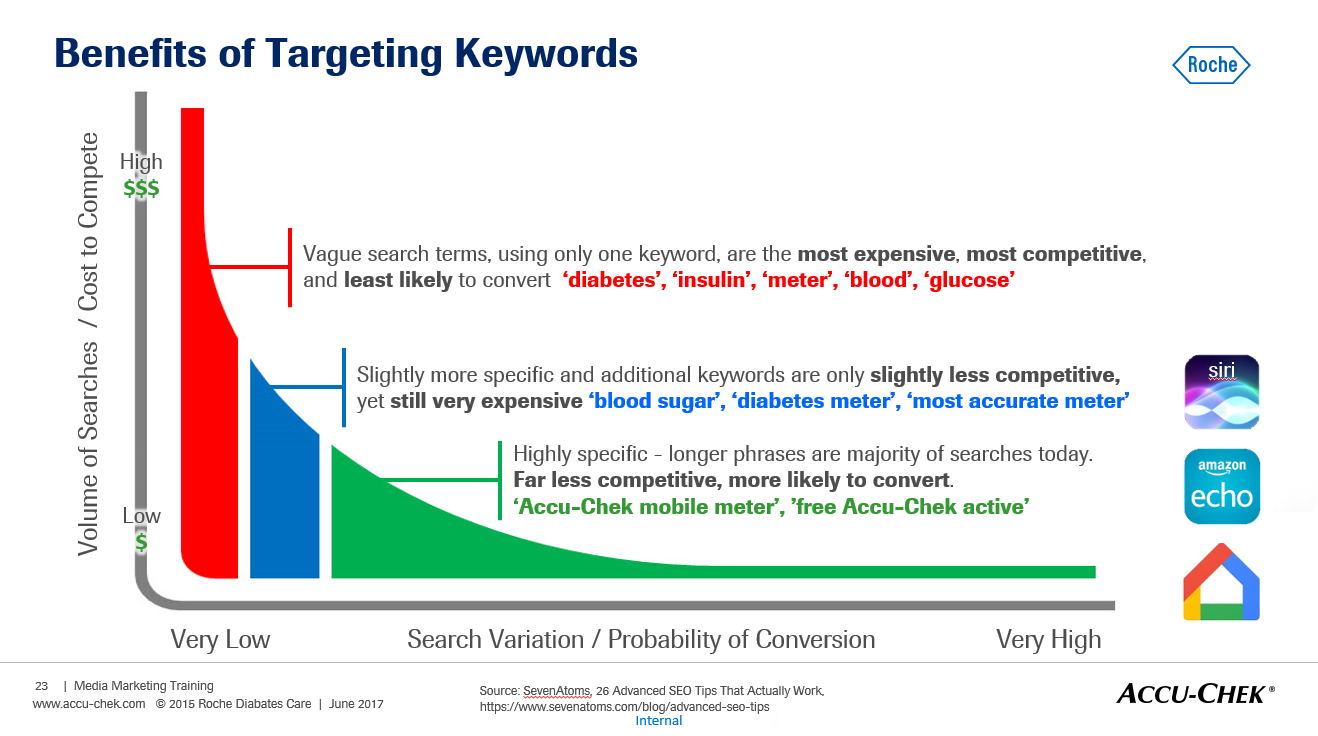
- Vague search terms using only one keyword are the most expensive, most competitive, and least likely to convert. (words like ‘diabetes’, ‘insulin’, ‘meter’, ‘blood’, ‘glucose’). If someone is searching for "diabetes," we don't know if they want a information on a blood glucose meter or if they are researching a term paper. It is very hard to determine the likelihood of influencing a brand decision based on a single word.
- Slightly more specific and additional keywords are only slightly less competitive yet still very expensive. (phrases like ‘blood sugar meter’, ‘most accurate meter’)
- Highly specific and longer keyword phrases make up the majority of searches today. They are also far less competitive and most likely to convert. (phrases like ‘free accuchek active,’ ‘accu-chek mobile meter’)
As a website owner and content creator, you want the words on your site pages to contain the same keywords that people are searching. This gives them a better chance of finding your content among the results.
How many keywords do people usually use?
Placing all your hopes (and budget) on single keywords isn't the most advisable thing to do. It is very difficult to infer a person's search intentions or questions based on a single word.
| Keywords | 1 to 2 words | 2 to 3 words | 4 + words |
| Search volume | High | Medium | Low |
| Conversion rate | Low | Medium | High |
What are long-tail keywords?
Keywords can be very broad or they can be very specific. While single keywords might appear to be valuable because of their high volume, they usually have extremely tough competition which raises the price. When you combine keywords in a search, this is called "long-tail keywords." Long-tail keywords usually have a more clearly defined intent.
What are exact-match keywords?
An exact match keyword indicates that your target keyword exactly matches a search query, text in a link, or domain name. Exact-match search results perfectly match all of the keywords in the search query, exactly as entered.
What are partial-match keywords?
A partial match means that your keyword is included among other words in a phrase or string. They match some part of the keywords in the search query, but not all of it (or in a different order).
Other types of match types
Another type of keywords is broad match. This type of keyword is more categorical, which means your ad might show up for similar terms that Google considers relevant. Your ad may show up for searches with your target keyword nestled inside a longer phrase.
What is Keyword Research?
Keyword research involves identifying the words and phrases people enter into search engines that are most aligned to our business and what we can offer customers. Researching keywords gives us a couple of things:
- Keyword research gives us a better understanding of how high the demand is for the keywords that we think are important to us.
- Keyword research helps us identify the many varied ways that people use language to research an idea or topic. We may not be aware of what people are feeling and thinking when they research their diabetes and the words they use. We must be open to leveraging the keywords customers use and not just the marketing focused words or internal words we like about our products and services.
- Keyword research can help fuel content development. Ultimately, by researching the words people type into search engines and using this research to create targeted-relevant content that directly meets the needs of customers.
Search language shifts rapidly, so it is advisable to do keyword research on a periodic basis.
- Whenever you're looking to create new website content.
- When you're deciding how to promote a particular product or service.
- When you’re wanting to drive a new campaign.
Check out some other articles